

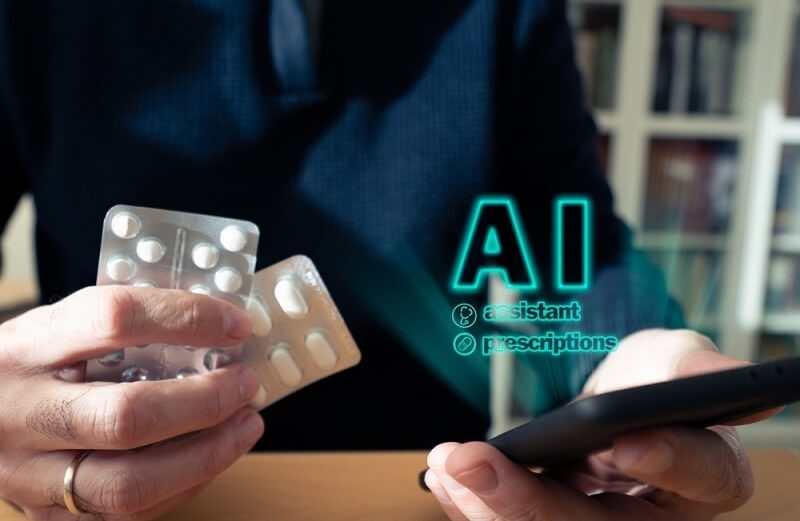
Artificial Intelligence (AI) will drastically change the way we discover, test, and sell drugs. The use of AI in drug development has enabled companies to drastically reduce development time and costs by leveraging advanced machine-learning algorithms, automated pharmaceutical research technologies, AI-based clinical trial designs, and data-driven analytics. In addition to AI technology used in conjunction with automated drug discovery systems and predictive biological software, these new technologies, together, are developing a highly accurate, intelligent, and automated environment for drug development.
In the past, the traditional method of developing drugs took over ten years of research and billions of dollars in research costs to bring a drug to the market, with a very difficult regulatory approval process and strict testing requirements for a drug's safety as determined by the U.S. Food and Drug Administration (FDA). The application of AI will revolutionize this process by providing a data-driven approach to drug development that enables unprecedented computational speed.
Artificial intelligence has increased the speed at which scientists can discover medicines through research by enabling access to vast biological, genetic, and chemical datasets to identify the medicines we need to develop and have at our disposal.
It uses algorithms designed to find patterns in large datasets of biomedical information. The beauty of this is that, instead of manually sifting through millions of molecules, AI models can identify molecules based on their structure and likelihood of interacting with other compounds.
As funding from the National Institutes of Health (NIH) continues to provide great opportunities for scientific research, organizations are increasingly turning to AI and computational biology to interpret genomic sequencing and other datasets.
Machine learning pharmaceutical research allows researchers to do many things, like:
So in the end, what machine learning does for drug discovery is provide scientists with very large amounts of data that enable them to conduct earlier-stage research much faster and much more accurately.
Many modern applications of predictive biology use computer algorithms to simulate molecular interactions in living organisms (e.g., humans, animals). These algorithms enable researchers to simulate the cellular response to a given combination of molecules without the need for physical testing. The use of predictive biology software is enhanced by sophisticated, robust biotech AI-enabled platforms that provide access to genomic, proteomic, and clinical data from patients.
Predictive biology software is the foundation upon which the biotech AI-enabled platform creates an integrated and automated environment to support drug development. On this platform, automated drug development tools will provide workflow management, compound synthesis optimization, and regulatory compliance documentation tracking. The use of AI in drug-discovery efforts allows for only the best candidates to progress through the testing phases.
Traditional clinical trials are expensive, time-consuming, and often carry significant risk. According to statistics from the U.S. National Library of Medicine, many drug candidates fail in Phase II or Phase III clinical trials due to safety or efficacy concerns. This is where the concept of using AI-based clinical trials emerges.
Algorithms analyzing vast numbers of electronic health records, genomic markers, and lifestyle variables will help with participant identification. This will:
By integrating machine-learning-based AI into drug discovery, pharmaceutical companies will be able to predict how patients will respond to treatment before conducting trials. In addition, AI-based clinical trials leverage data from wearable and remote patient monitoring technologies to monitor patients and identify adverse events sooner.
Automated tools will help facilitate drug development while providing a better track record of documentation and regulatory compliance, and will also be used to automate clinical trial development. By using AC-driven automated technologies, sponsors can reduce human error in data entry by automating data cleaning and analysis, as well as improve regulatory reporting and review processes.
In an effort to support the responsible implementation of AC, organizations worldwide are beginning to adopt the World Health Organization's framework. As AI-based drug discovery continues to develop, more and more companies will increase their use of automated solutions to accelerate their path to submitting applications to regulatory agencies.
The integration of biotechnology, Artificial Intelligence platforms, and predictive biological software signals a major shift in precision medicine. Why is this so important?
Biotech AI platform "integration" allows for combined:
This complete and continuous connection enables AI in drug discovery to be consistent and data-rich at all stages of drug development, from Discovery through Preclinical to Clinical to Post-Market. Pharmaceutical research that uses ML continuously improves predictive modeling by adding new data results.
Traditional pharmaceutical research and development (R&D) can cost more than $2 billion per drug. The use of AI in drug discovery substantially reduces the cost of the early-stage screening process. In addition, predictive biological software will eliminate weak candidate drugs through laboratory testing, while automation tools in drug development will reduce administrative costs.
Financial documentation has been made available to select global regulators (e.g., the U.S. Securities and Exchange Commission), demonstrating significant growth in biotechnology investment in AI infrastructure. Investors understand that biotechnology and Artificial Intelligence platforms enable the measurement of return on investment by minimizing the risk of failure in later stages of drug development.
As artificial intelligence advances in drug discovery, transparency and governance will be critical. The regulatory agencies are focusing on three areas when evaluating the rules for using AI in drug discovery:
1. Algorithm accountability
2. Reducing bias
3. Compliance with data privacy laws
When utilizing AI in Clinical Trials, an ethical approach must be adopted when using patient data in machine learning for pharmaceutical research. Predictive Biology Tools should provide interpretability to enable scientists to validate outcomes.
Government-sponsored guidelines support collaborative oversight of automated tools used in drug development to ensure compliance with safety protocols. The future success of biotechnology AI platforms depends on the trust, transparency, and scientific rigor of such tools.
AI in the pharmaceutical industry has undergone a major shift from a trend to a structural transformation in how we conduct biomedical science. Machine learning will be incorporated into pharma research and use multi-omic data in real-time. A combination of predictive modeling will enable the use of adaptive clinical trial protocols that adjust as needed.
Using Predictive Biology software, we will have available individualized treatment options based on each individual's genetic profile. The pharmaceutical automation process will eliminate redundancies, streamlining global product approval. Additionally, the creation of Biotech-AI networks will provide a robust research infrastructure worldwide.
As regulatory agencies continue to develop the digital frameworks for using AI in drug discovery, what has been previously accelerated will become an enabler of innovation by creating therapies that are unimaginable today.
Artificial Intelligence (AI) is at the leading edge of evolution in science with its use of machine learning for pharmaceutical research, AI-based clinical trials, predictive biology software, automated drug development tools, and biotech-enabled (AI) platforms to create a smarter, quicker, and more exact future for the pharmaceutical industry. As respected institutions provide guidance on ethical principles, AI will revolutionize medicine for future generations by redefining the way drugs are discovered.
The use of AI for Drug Discovery enables researchers to analyze vast amounts of biological data using machine-learning-based models for drug development. By identifying potential drugs quickly, it significantly reduces the time required for early-stage validation through a more efficient process than traditional laboratory work, when combined with a predictive biology software program and a drug development automation tool.
Yes, AI clinical trials are closely regulated by organisations such as the Food and Drug Administration (FDA) and the World Health Organisation (WHO). Through the use of artificial intelligence and advanced analytics, clinical trials will be subject to stringent regulations regarding patient safety, ethical clinical trial conduct, and the validation of clinical trial data.
Biotech AI platforms operate within all three phases of pharmaceutical research: drug discovery, drug testing, and drug approval by integrating various sources of research data, predictive biology software, and drug development automation tools. These platforms support the continuous use of machine learning based models for pharmaceutical research by improving efficiency, lowering the risk of developing new drugs, and supporting innovation related to personalized medicine.
This content was created by AI