

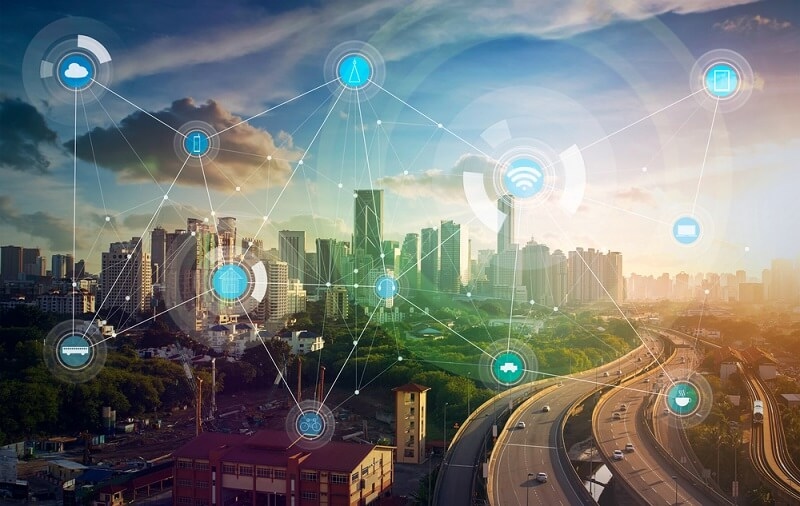
Here’s the thing about cities in America right now. They’re not just growing; they’re thinking. Streetlights adjust to traffic, buses send real-time updates, and water systems quietly report leaks before anyone notices. From New York to Austin, local governments are weaving technology into the bones of urban life. And it’s not just about shiny gadgets. It’s about safety, efficiency, sustainability, and, honestly, making daily life feel less chaotic. This blog walks through how smart cities are reshaping the American urban landscape through urban digital infrastructure, IoT city management systems, sustainable urban planning technology, AI traffic optimization, and connected city innovations.
Smart cities are no longer a futuristic pitch deck idea. They are active, evolving ecosystems where data, sensors, and software work quietly behind the scenes. The goal is simple: better services, cleaner streets, smoother commutes, and more responsive government.
A smart city uses technology to improve how it runs. That includes transportation, utilities, public safety, and even waste collection. It is less about flashy apps and more about coordination.
Think about it like this. A city is a living organism. Roads are arteries. Utilities are veins. Data is the nervous system. When data flows well, decisions improve. When it stalls, everything slows down.
Key features often include:
Cities like Los Angeles and Chicago have adopted sensor networks to monitor traffic and air quality. These systems feed dashboards that city officials review daily. It sounds technical, and it is. But at its core, it’s common sense powered by code.
Urban digital infrastructure is the quiet hero here. High-speed broadband, 5G networks, cloud platforms, and secure data centers form the foundation. Without them, none of the smart systems function.
You might not see fiber optic cables under your sidewalk, but they carry the information that keeps public WiFi running in parks and allows emergency services to coordinate faster. Companies like Cisco and IBM often partner with city governments to design and maintain these systems.
And yes, cybersecurity matters. When traffic lights and water systems connect to networks, protection becomes non-negotiable. Cities are investing heavily in digital security teams to guard public data.
Now let’s zoom in on IoT city management systems. IoT stands for Internet of Things, which basically means devices talking to each other through the internet. Sounds simple. It isn’t.
Water meters can now detect leaks in real time. Waste bins can signal when they are full. Energy grids can balance supply and demand automatically.
Imagine a hot summer in Phoenix. Energy use spikes. Instead of blackouts, the smart grid adjusts loads and alerts operators. That’s not magic. It’s connected sensors paired with software analytics.
Benefits include:
The payoff is practical. Residents save money. Cities reduce strain on aging infrastructure.
Here’s where it gets personal. Smart surveillance systems can detect unusual movement patterns in public spaces. Shot detection sensors can alert police within seconds. Emergency vehicles can receive priority at traffic signals.
It’s a tricky balance between safety and privacy. Americans care deeply about civil liberties, and rightly so. Many cities now hold public forums before deploying new surveillance tech. Transparency builds trust. Without it, smart initiatives stall.
Let us explain something that often gets overlooked. Smart cities are not only about speed and efficiency. They are also about sustainability. Climate concerns are reshaping urban priorities across the United States.
Sustainable urban planning technology helps architects design buildings that consume less energy. Smart thermostats, solar integration, and automated lighting reduce waste.
Cities like Seattle and Boston use digital modeling tools to simulate how new developments will impact traffic flow, sunlight exposure, and even wind patterns. These simulations guide zoning decisions.
Developers are using software to predict energy use years before a building opens. That kind of foresight matters. It lowers emissions and cuts costs long-term.
Electric buses, bike share systems, and charging stations are part of connected city innovations. When paired with real-time data, these systems encourage residents to choose cleaner travel options.
Picture this. You open a city app and see that a bus will arrive in three minutes. Suddenly, driving feels less appealing. Small shifts like that add up.
Sustainable urban planning technology also supports walkable neighborhoods. Data shows where sidewalks are missing or where pedestrian accidents cluster. Planners can then fix problem areas with precision rather than guesswork.
Traffic is one of the biggest pain points in American cities. No one enjoys sitting in bumper-to-bumper congestion on a Monday morning. That’s where AI traffic optimization steps in.
Artificial intelligence analyzes traffic patterns in real time. It adjusts signal timing based on vehicle flow rather than fixed schedules. If one direction gets crowded, the green light lasts longer.
In cities like Pittsburgh, adaptive traffic systems have reduced travel times noticeably. The effect feels subtle at first. But over weeks and months, commuters gain back hours.
Traffic data does more than manage signals. It informs long-term planning. City engineers study congestion maps to decide where new transit lines or bike lanes make sense.
Here’s the interesting part. Sometimes data contradicts intuition. A road that seems busy might not be the real bottleneck. Numbers reveal patterns human eyes miss.
Smart cities are reshaping urban America through technology that feels both visible and invisible. Urban digital infrastructure forms the base. IoT city management systems streamline services. Sustainable urban planning technology supports greener growth. AI traffic optimization eases congestion. Connected city innovations strengthen public engagement.
The real story, though, is not about machines. It’s about people. It’s about the parent who gets home earlier because traffic flows better. The small business owner who pays permits online without missing work. The resident who breathes cleaner air.
Smart cities operate with the use of digital tools and data to enhance their services, such as traffic, utilities, and safety. The focus is on improved living standards and optimization of the city management.
They are also used to monitor resources in real time by connecting devices such as sensors and meters. The result is faster repairs, less wastage, and reliable government services.
Yes, when properly managed. With traffic data, AI ensures that signal timing is improved, and this will reduce the period of congestion and reduce the time that emergency responders take.
It endorses wide band, cloud computing, and safe networks that drive every smart service. It is not possible to operate connected city innovations without it.
This content was created by AI